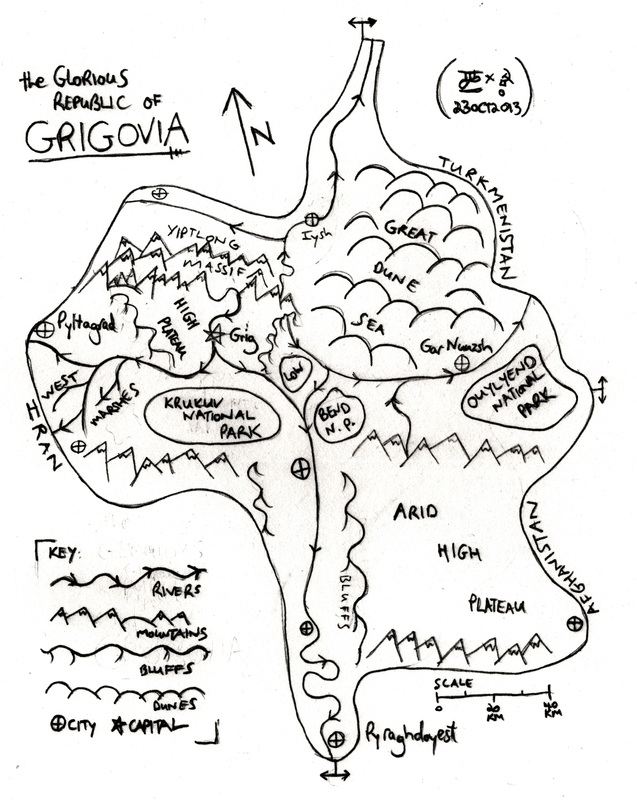
The Glorious Republic of Grigovia is a landlocked nation in Central Asia. Its neighbors are Iran, Turkmenistan, and Afghanistan. Roughly 200 kilometers north-to-south and 160 kilometers east-to-west, the first known reference to Grigovia is in 'The Histories,' by Herodotus. Marshy bogs lie to the south and west of its capital, Grig (population 120 thousand), which sits on an elevated plateau in the southern foothills of the Yiptlong Massif mountain chain. The Yiptlong has significant deposits of iron-ore, coal, and sulfur that have been mined for centuries. West of the capital is Pyltagrad, a culture-rich city of roughly 50 thousand inhabitants. East of the capital is the Great Dune Sea, an arid former lake bed; Gar Nuuzsch, population 60 thousand, is the primary city in the east – its patroness is Nuuzstathena, goddess of war, technology, and guile. Other deities include Ganestrix (an ant-headed goddess of travel and good fortune) and Oumbast (goddess of cats as well as gracefulness in the face of overwhelming odds). The main city in the south is Pryaghdoyest, an export-oriented manufacturing hub, population 75 thousand; north-east of Pryaghdoyest is an arid plateau with significant deposits of rare-earth metals. Tens of thousands of Yaelong tribes-people call this nation home, living scattered about, primarily in the Yiptlong Massif. Known for their fierce independence and fervent defense of the high plateaus, the Yaelong were feared by Alexander the Great as well as subsequent invaders. A parliamentary democracy with strong socialist traditions, the Grigovian royal family abdicated in the early 20th Century in a sign of respect for the nation's growing anarcho-communist movement, which is still strong today. Group workshops and livings spaces known as 'su'uvyiets' provide training and support in a wide variety of crafts, trades, and skills, each 'su'uvyiets' operating under the loose umbrella of its mother organization. Never in its history has Grigovia been fully conquered (it was the only fully autonomous republic of the USSR), largely because of an extensive tunnel system that runs under almost all of Grig. Most of these tunnels are well maintained and still in use as winter shelters, manufacturing areas, and weapons stores. Robotic and autonomous buses serve outlying villages, and the capital features a dense network of public transportation systems – trams, trolleys, and 4 subway lines. Renewable energy powers roughly 60% of electricity needs, and plans call for the nation to receive nearly all of its power from wind and geothermal sources by the year 2030. Modern Grigovia traces its founding to the semi-mythical Krukuv, a former monk who settled there sometime during the 9th Century C.E., digging a series of deep and sturdy tunnels (for to store his beloved tubers) and taking a Yaelong bride as his mate. Popular recreational activities include hiking, cycling, folk festivals, story-telling competitions, martial arts training, and winter sports; camping is permitted on all public and many private lands. Famous for its tendency to warmly receive immigrants fleeing war and economic turmoil, the population of Grigovia has increased by nearly 9 percent in recent years due to the ongoing conflict in Syria. With strong banking houses, a robust services sector, and a variety of cottage industries that make everything from coo-coo clocks to firearms, the Grigovian economy has proven all but immune to international market volatility, being able to quickly retool according to shifting demand while keeping unemployment at well under 3% for a population nearing 400 thousand souls. In the decades since the Rus and Ynki invasions of Afghanistan, trade with Iran has increased tenfold, primarily heavy machinery from Grigovia's well-developed manufacturing sector. An outspoken critic of Ynki involvement in regional conflicts across the globe, the Glorious Republic of Grigovia has repeatedly demanded that the various peoples of the world enjoy the right to determine their own path in life for themselves, free of foreign intervention. For more on all things Grigovia, please visit www.welcomehome.ggv.
© americanifesto / 場黑麥

americanifesto.com | updated Tuesday, Thursday, Sunday
Showing posts with label yiptlong. Show all posts
Showing posts with label yiptlong. Show all posts
09 February 2016


05 August 2014
under the hoofs
Great salvos impacted on turret and gate, each one a reminder of perilous fate. We were few in number, who had stood our ground, who in Nuuzstathena much courage had found; through hell and high water she'd been at our side while peoples around us had crumbled and died, crushed under the hoofs of the Mungul invaders or sold out by cowards and dastardly traitors. Pushed back to our fortresses in the Yiptlong we'd watched as our enemies jumbled and thronged and pulled down our temples and destroyed our homes and defiled most everything that we'd known. With food supplies shrinking and hope running low there came a most sudden and Summertime snow that covered our mountains and enemies too, who watched as their fingers turned dark shades of blue, then watched as their digits went black and fell off and consumed their horses or ate from their troughs. The Goddess appeared at one morning's first light and spoke to us, saying, Don't give up the fight but fall on your enemies during this night dressed up as crazed demons awaken their fright. The Munguls were weakened by cold and disease, they broke with a sickly and half-hearted ease, we drove them straight down to our great river's banks where we took a moment to give sincere thanks. With swords in our clutches and light in the sky we stood up and sounded a great battle-cry, then rushed at the ranks of our once-mighty foes, destroying their spirit while they wept and froze. They begged us allow them to run from our lands, they stepped on their weapons and threw up their hands, we marched them immediately to our border with pride in our bosoms and fine marshal order. To honor the wisdom of 'Thena divine we built of some rockfall a victory shrine right there on the border at the very spot where Mungul invaders our people forgot. The shrine is still standing these many years on, we go once a year at the first light of dawn with handfuls of flowers and flagons of wine, we would love to see you there – join us next time.
© americanifesto / 場黑麥
© americanifesto / 場黑麥
31 July 2014
blessed steppe mother
Our own modest steppe-land is not like another – watched over, protected, by blessed Steppe Mother. She shelters all animals under her wing and cares for the smallest and biggest of things, for field-mouse and springbok and furry cave-bat, for lizard, mosquito, and tiny sand-cat. Her colors are azure and ocher and gold, of her glory is in old stories much told, she makes all the grasses and midget trees bloom with dazzling blossoms and miniature plumes. Her watch never wavers through daytime and night, her justice is brutal and sudden and Right, her worshipers leave very few lasting traces to prove that they've been to the offering places. Her voice can be heard in the strong piercing winds that blow away evil and erase our sins, that race down the Yiptlong so steep and so high, as soon as the summers begin to turn dry. So come seek her presence, it is always near, it makes the soul vibrate and brings men to tears while women and babies just laugh with delight quite devoid of sorrow and empty of fright.
© americanifesto / 場黑麥
© americanifesto / 場黑麥
31 October 2013
on curing SAD
For nearly a century, Grigovian researchers puzzled over the abnormally large numbers of depressed people living in deep valleys high up in the Yiptlong Massif. Some blamed the soured spirits on economics or politics or religion, but a few tenacious scientists began to see patterns in their data, patterns that cut across economic and religious and political lines. Was something in the water fouling the collective mood? they asked, and, Could the cause be genetic? Questions vanished with the discovery of Seasonal Affective Disorder (SAD), a condition brought about primarily by insufficient exposure to sunlight. In the wake of SAD, tanning salons in Grigovia's larger cities did a brisk business, but persons living in outlying areas remained depressed, sullen, withdrawn, and grumpy. Plans were drawn up to install artificial sunlight delivery units in public baths in regional population centers throughout Grigovia's higher elevations, but the projected maintenance and electrical costs involved were deemed too high. Then, however planners heard about a Norwegian town installing arrays of sun-tracking heliostats on the tops of the hills that used to shield it from the light of Sol, and they raced to set up copycat operations on Grigovian soil. The first bank of sun-tracking heliostats has been installed 15 kilometers north-west of Grig in the town of Phuir, where it now redirects, on sunny days, a constant stream of bright sunlight onto the town's central square. Local health officials indicate that, at least among the town's elderly persons wheeled out into the square on cloudless days, moods seem to be lifting. More on this story as it develops. Huzzah.
© americanifesto / 場黑麥
© americanifesto / 場黑麥
23 September 2013
thermal springs reopen
As part of its nation-wide efforts to improve the health and well-being of its inhabitants, the Glorious Republic of Grigovia announced the reopening of the Lower Eastern Yiptlong Hot Springs & Baths (LEYHS&B). Shuttered shortly after Grigovia's independence – in 1988 – from the Union of Soviet Socialist States, LEYHS&B sat dormant and neglected until 1994. Then, a group of private investors conspired with the Grigovian Ministry of the Interior to not only restore the Art -Deco-style bath houses to their former glory but also tap the region's geothermal capacity to provide heating and electricity to the baths and some neighboring communities. At one time closed to all but the most well-connected cadres of the former Soviet regime, LEYHS&B is now accessible to citizens and tourists via Grigovia's robotic bus system. (Buses depart regularly from the town square in Eiyehrdo Ghassdt, a proud village that lies about halfway between Grig and the eastern city of Gar Nuuzsh.) Famous for wide pools of swirling hot waters as well as frigid dipping basins, visitors to LEYHS&B can now enjoy also a full spectrum of spa treatments that include world-class massages, Finnish-style sauna, archery and martial arts lessons, and guided horse-back or hiking tours of the majestic Eastern Yiptlong massif. Expect stunning views of the Great Dune Sea as well as many happy times with your friends and loved ones at our beloved Hot Springs & Baths. Be sure to visit the adjacent Happy Times Smoking Lodge, where all manner of combustible leaves, tars, and saps from around the world are available for purchase and consumption. Come soon, please, and relax.
© americanifesto / 場黑麥
© americanifesto / 場黑麥
02 August 2013
Grigovian folk belief
Theirs is a society founded on strongly secular roots, but the Grigovian people do practice some forms of folk religion, a select few of which are examined here. First, and perhaps most widespread, is Sighting First Rays, a ceremony held every morning after the daily yoga practice in honor of the first shining tendrils of sunlight to grace the resplendent peaks of the towering Yiptlong massif. This ceremony consists of pausing one's actions, moving so as to be able to see the Yiptlong massif, and watching closely as its peaks are drenched in sunlight. Second-most widespread after Sighting First Rays is a ceremony known as Clarified Unity, in which one sits quietly for a certain amount of time in order to clarify the inner vision and unify the often competing energies of body and stomach and mind. A meditative custom, practitioners of Clarified Unity swear that it helps to reduce distress and worry and to lessen the ravenous cravings of addiction – including those involving food, sex, and self-mutilation. The third most widespread religious practice is Seeing Smallest Beauty, a process by which people look for symmetry in all things, even in those instances – death or destruction or illness – that other societies vilify. Seeing Smallest Beauty leads directly into Walking Beautifully; practitioners of these closely interrelated methods remain detached from the notions of honor and dishonor, profit and loss, benefit and harm, following rather the dictates of their hearts and acting in accordance with Universal patterns. The final belief system examined here is Honoring Good & Bad, a ritual that acknowledges the fickle whims of the Tunnel Pixies. Sometimes helpful and sometimes harmful, Tunnel Pixies are blamed not only for leading children miraculously unharmed out of caved-in sections of tunnel but also for having caused the cave-ins in the first place. Belief in these mischievous beings stretches back to at least the 15th Century, when Briny the Younger – Grigovia's preeminent medieval bard – sang, 'Here they pull on loose brick, and there they light the way, their moods are not for wondering, for these shift with each day.' Examined here are but a few of the customs of the Glorious Republic of Grigovia. Come visit, and discover more for yourself!
mentiri factorem fecit – 場黑麥
mentiri factorem fecit – 場黑麥
28 July 2013
Grigovia issues awards
Following Germany's courageous decision to award its highest whistle-blower prize to Edward Snowden for his willingness to expose tyrannical and unjust actions perpetrated by the federal government of the United States of America, the Glorious Republic of Grigovia announced it would select for Outstanding Champion of Liberty Award (OCLA), an annual recognition ceremony. Entities that win this prestigious prize receive asylum anywhere within Grigovia's borders, the right to stay and be freely productive in any of Grigovia's fine cities, as well as two kilograms of 14 karat gold or a two-acre plot of land in the foothills of the Yiptlong massif, which lies north of Grig, this small, landlocked nation's capital. Among the selections for this year's OCLA prize are America's Edward Snowden, China's Ai Weiwei, Bolivia's Evo Morales, the children of Occupied Palestine, and the inhabitants of Egypt's port cities along the Suez canal. “2013 has been a good year for the fight against tyrannical overreach,” said Eyohwah Thrask-Ullyennd, chairwoman of Eastern Grigovian University's department of social upheaval and revolutionary studies who sits on the board that makes the final decision on who will receive OCLA. She continued, saying: “So long as there are individuals and groups who will risk Life, Liberty, and sacred Honor to safeguard the freedom of others, standing up to the oppressive and violent regimes under which so many people around the world silently suffer, there is hope for mankind. With the Outstanding Champion of Liberty Award, we aim to encourage people to keep demanding of their governments upstanding and just behavior and to keep exposing injustice and corruption wherever these twin evils should raise their ugly heads.” Reports indicate that the Grigovian people danced in the streets upon hearing about OCLA.
mentiri factorem fecit – 場黑麥
mentiri factorem fecit – 場黑麥
25 June 2013
Snowden granted asylum
In a calm and business-like parliamentary maneuver every last minister and elected official with voting rights in the general assembly of the Glorious Republic Of Grigovia voted to extend political asylum as well as full citizenship to one Edward Snowden, the brave young man who exposed the cruelty of Ynki imperialism and outed Barack Hussein Obama as one of the worst American presidents on record. In the official statement released shortly after the vote, a united Grigovia said (referencing, of course, the book Catch 22 by Joseph Heller): “Qui ils sont les Snowdens d'antan? Well, Snowden is fucking here, maybe hiding in the vasts tunnels under Grig, maybe holed up in the deep caves that dot the Yiptlong massif, and he's not going anywhere – not to Guantanamo Bay nor to the purple plains of misery – so fuck off, Ynki scum, and leave this hero of Libertie and Free Speech alone.”
mentiri factorem fecit – 場黑麥
mentiri factorem fecit – 場黑麥
Subscribe to:
Posts (Atom)